Execution Format
Execution Format
Vector is the container format used to store in-memory data during execution. DataChunk is a collection of Vectors, used for instance to represent a column list in a PhysicalProjection operator.
Data Flow
DuckDB uses a vectorized query execution model. All operators in DuckDB are optimized to work on Vectors of a fixed size.
This fixed size is commonly referred to in the code as STANDARD_VECTOR_SIZE. The default STANDARD_VECTOR_SIZE is 2048 tuples.
Vector Format
Vectors logically represent arrays that contain data of a single type. DuckDB supports different vector formats, which allow the system to store the same logical data with a different physical representation. This allows for a more compressed representation, and potentially allows for compressed execution throughout the system. Below the list of supported vector formats is shown.
Flat Vectors
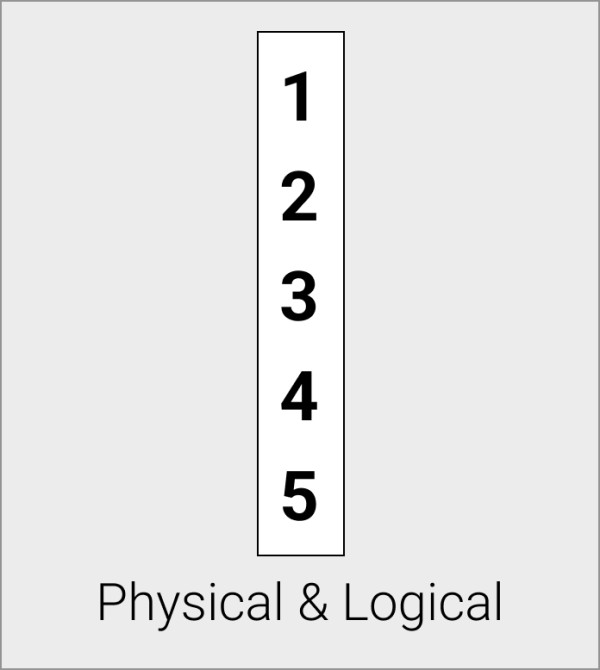
Flat vectors are physically stored as a contiguous array, this is the standard uncompressed vector format. For flat vectors the logical and physical representations are identical.
Constant Vectors
Constant vectors are physically stored as a single constant value.
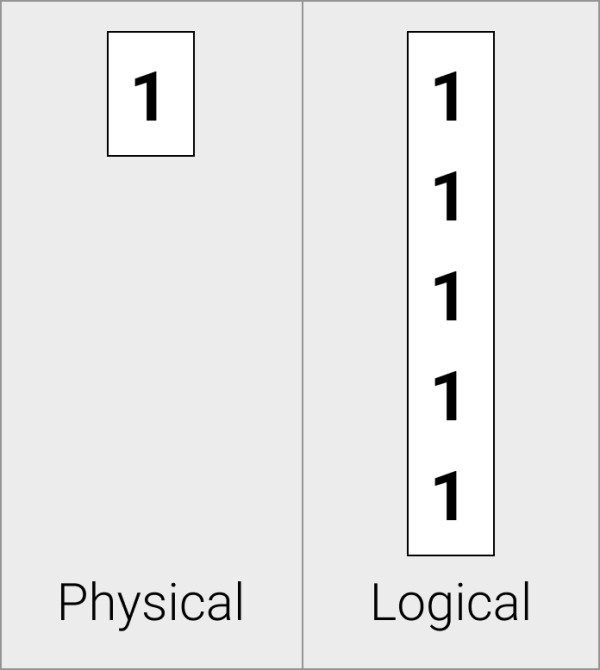
Constant vectors are useful when data elements are repeated – for example, when representing the result of a constant expression in a function call, the constant vector allows us to only store the value once.
SELECT lst || 'duckdb' FROM range(1000) tbl(lst);
Since duckdb is a string literal, the value of the literal is the same for every row. In a flat vector, we would have to duplicate the literal 'duckdb' once for every row. The constant vector allows us to only store the literal once.
Constant vectors are also emitted by the storage when decompressing from constant compression.
Dictionary Vectors
Dictionary vectors are physically stored as a child vector, and a selection vector that contains indexes into the child vector.
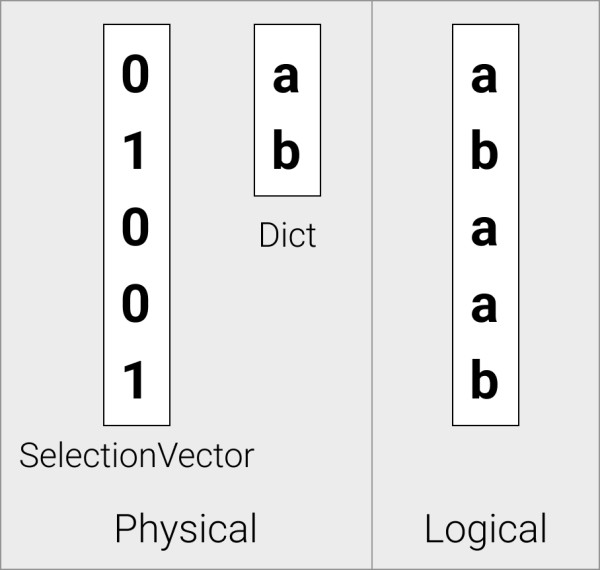
Dictionary vectors are emitted by the storage when decompressing from dictionary
Just like constant vectors, dictionary vectors are also emitted by the storage. When deserializing a dictionary compressed column segment, we store this in a dictionary vector so we can keep the data compressed during query execution.
Sequence Vectors
Sequence vectors are physically stored as an offset and an increment value.
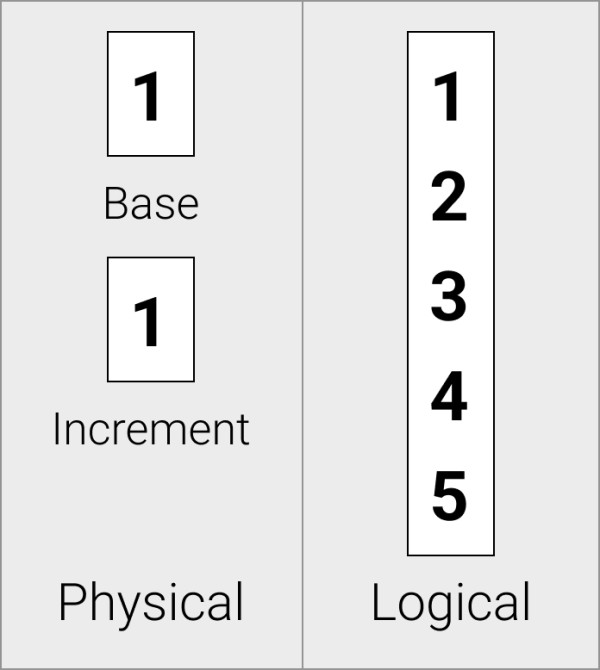
Sequence vectors are useful for efficiently storing incremental sequences. They are generally emitted for row identifiers.
Unified Vector Format
These properties of the different vector formats are great for optimization purposes, for example you can imagine the scenario where all the parameters to a function are constant, we can just compute the result once and emit a constant vector. But writing specialized code for every combination of vector types for every function is unfeasible due to the combinatorial explosion of possibilities.
Instead of doing this, whenever you want to generically use a vector regardless of the type, the UnifiedVectorFormat can be used. This format essentially acts as a generic view over the contents of the Vector. Every type of Vector can convert to this format.
Complex Types
String Vectors
To efficiently store strings, we make use of our string_t class.
struct string_t { union { struct { uint32_t length; char prefix[4]; char *ptr; } pointer; struct { uint32_t length; char inlined[12]; } inlined; } value; };
Short strings (<= 12 bytes) are inlined into the structure, while larger strings are stored with a pointer to the data in the auxiliary string buffer. The length is used throughout the functions to avoid having to call strlen and having to continuously check for null-pointers. The prefix is used for comparisons as an early out (when the prefix does not match, we know the strings are not equal and don't need to chase any pointers).
List Vectors
List vectors are stored as a series of list entries together with a child Vector. The child vector contains the values that are present in the list, and the list entries specify how each individual list is constructed.
struct list_entry_t { idx_t offset; idx_t length; };
The offset refers to the start row in the child Vector, the length keeps track of the size of the list of this row.
List vectors can be stored recursively. For nested list vectors, the child of a list vector is again a list vector.
For example, consider this mock representation of a Vector of type BIGINT[][]:
{ "type": "list", "data": "list_entry_t", "child": { "type": "list", "data": "list_entry_t", "child": { "type": "bigint", "data": "int64_t" } } }
Struct Vectors
Struct vectors store a list of child vectors. The number and types of the child vectors is defined by the schema of the struct.
Map Vectors
Internally map vectors are stored as a LIST[STRUCT(key KEY_TYPE, value VALUE_TYPE)].
Union Vectors
Internally UNION utilizes the same structure as a STRUCT. The first “child” is always occupied by the Tag Vector of the UNION, which records for each row which of the UNION's types apply to that row.
网址:Execution Format https://mxgxt.com/news/view/1719101
相关内容
The Mono log profilerCVE
Room for Escape: Scribbling Outside the Lines of Template Security
OWASP Top Ten 2017
卡罗琳·奥尼尔
爱豆,拉近你们的距离– Appchina应用汇
GO Archive
JSON Overview
国联股份高级副总裁、涂多多CEO刘斋一行到访正威国际集团国联股份高级副总裁、涂多多CEO刘斋一行到访正威国际集团
一种社交网络名人信息推荐装置的制作方法
随便看看
最新实时动态
- 公主拼命护她,亲爹却要把她流放
- 叶平君虞昶轩最接近幸福时自尽,用性命换自由
- 吴艳妮回应争议,破13秒20多次我就是很厉害
- 王一博魏若来民国时尚不正经解析③长衫男人的旗袍,华流学院风! 时尚穿搭
- 为什么会说娱乐圈配不上张国荣? 张国荣 哥哥 人物故事 人物传 张国荣哥哥
- 民宿和书屋全都黄了,谢之遥心里打鼓,晓春劝他别有压力
- 王嘉尔谈舞台态度,被骂一下也满足了
- 眼观六路耳听八方,这才叫察言观色! 庆余年 电视剧 范闲 洪竹 好剧推荐
- 那就看点能看的吧
- 欢迎收看动作大片《黄雀之这俩S手到底是谁》
热点实时动态
- 161188
- 35922
- 29971
- 29020
- 28111
- 27806
- 27344
- 26081
- 26049
- 25501